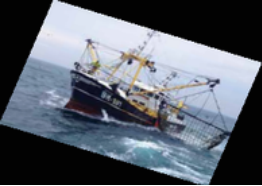
Brixham's Beam-Trawler Dover Sole Fishing Fleet
Ask any local person who has been around Brixham for a few years to tell you about the fishing fleet and they will probably talk about Dover Sole and Beam Trawlers. These things are today synonymous with the port, but it hasn't always been that way. In the 50s and early 60s, Whiting caught by “Otter” Trawlers was the catch of the day. The fishermen always changed fishing grounds through the seasons as different fish stocks came and went; sometimes Lemon Sole, other times Queen Scallops. Mackerel was taken inshore in the summer and further off from great shoals in the winter.
In the 70s, after the Whiting had fallen into decline, the Mackerel shoals arrived in abundance. Literally millions of tons of these striped cousins of Tuna gathered in the Southwest approaches and a “Klondike” took place over a few short winters the like of which has not been repeated, at least not in these waters. Many of the owners of today's
beam trawlers, not just in Brixham but also in Plymouth and Newlyn to the west, made a fortune from the Mackerel silvery harvest. By the early 80s, the migration pattern had modified, the shoals went to Scotland then Norway and that particular boom for the SW UK fleet was over.
However, another cycle of riches had already begun and Dover Sole became main-stay in the economics of the SW fleets, especially in Brixham.
The first “beamer” working out of Brixham in the modern era arrived from Holland in 1965. The ex-North Sea shrimp beamer, Helena Cornelia BM 169, was of 30tons” register” and was fitted with a 220HP engine. Trawler skippers had known there were stocks of Dover Sole and Plaice out in the deeper English Channel, particularly caught at night, but the side-winders with “otter” trawls were not really up to the job. North Sea boat owners, especially Dutch and Belgian, had started to exploit the rich stocks of these species with gear adapted from the original turn-of-the-20th-century-Brixham-design.
The trawl net is held open with a steel (originally wooden) pole. They had the engines and the gear to work the North Sea sand-banks, but fishermen did not know for sure that such gear would work on the rough grounds of the Channel. Many skippers were sceptical of this novel gear design. Some branded it as so destructive that fish in the Channel would be wiped out inside a decade. The first to try it certainly took a terrific economic gamble, but it paid off and Brixham hasn’t yet looked back.
By 1971, there was a fleet of 70 “boomers” throughout the SW. By 1984, 160 owners had tried the gear, although not all with good results. Some boats just weren't suited to twin-beaming, whereby a derrick on each side is used to suspend and tow a beam with associated trawl net. Sadly, there were a few accidents, some fatal, when the stability of a boat did not match up to the levers and weights of the gear. From 1985 onwards, for conservation reasons, the government restricted the fleet by capping license numbers.
The fleet stabilized at around 110 for most of the ten years to 1995, as the Ministry of Fisheries (MAFF) endeavored to ensure the conservation of fish stocks, in compliance with Common Fisheries Policy (CFP) Rules.
Since 1995, also as a direct result of government and EU policies, the fleet has been cut-back. More than half the fleet has been broken up, either by funded decommissioning or by owners voluntarily and at their own expense consolidating their quotas to stay legal. Those that are left now are facing tough restrictions on the number of days they are allowed to venture to sea. The regulators in Brussels believed the fleet grew too big for the Sole stock to cope.
Happily for Brixham, the Sole stock today is well-managed, is fished under control and scientists today say there is good recruitment to a growing Biomass. Since 2007, the fleet has been governed by a long-term multi-annual management plan (MAMP) that aimed to deliver maximum sustainable yield by 2015. In December 2011 the Fisheries Commissioner in Brussels celebrated that Channel Sole is one of the stocks now fished at Maximum Sustainable Yield (MSY), a target reached 3-years early!
The skippers continue to work with scientists to provide reliable data from commercial voyages that has been added to knowledge collected for decades on research vessels. Also they have worked with gear technologists to re-design their nets to have less impact on the seabed and to be more selective. Discards have been reduced by more than 60% using these clever nets.
The majority of Brixham skippers now run their vessels under the guidance of the Responsible Fishing Scheme (RFS), administered and certificated by the Sea Fish Industry Authority, (SFIA).
Confidence in the future is high. A strong fishery that supplements the fleet in winter is Cuttlefish, a non-quota species. Catches of this fish were very low and worthless until about 1994. Now continental markets have been found and in each year for a decade £4 million worth is landed. Scallop landings are of similar value and these shellfish are the 3rd economically in the UK!
Who knows what will be the next "gold-rush"?
Whatever happens, the fishermen of Brixham are tenacious. They intend to ride-out the storms created by the bureaucrats even if they have to shelter from those that nature
creates. For them life has always been a roller-coaster and they wouldn't have it any other way.
Jim Portus. Chief Executive SWFPO Ltd.